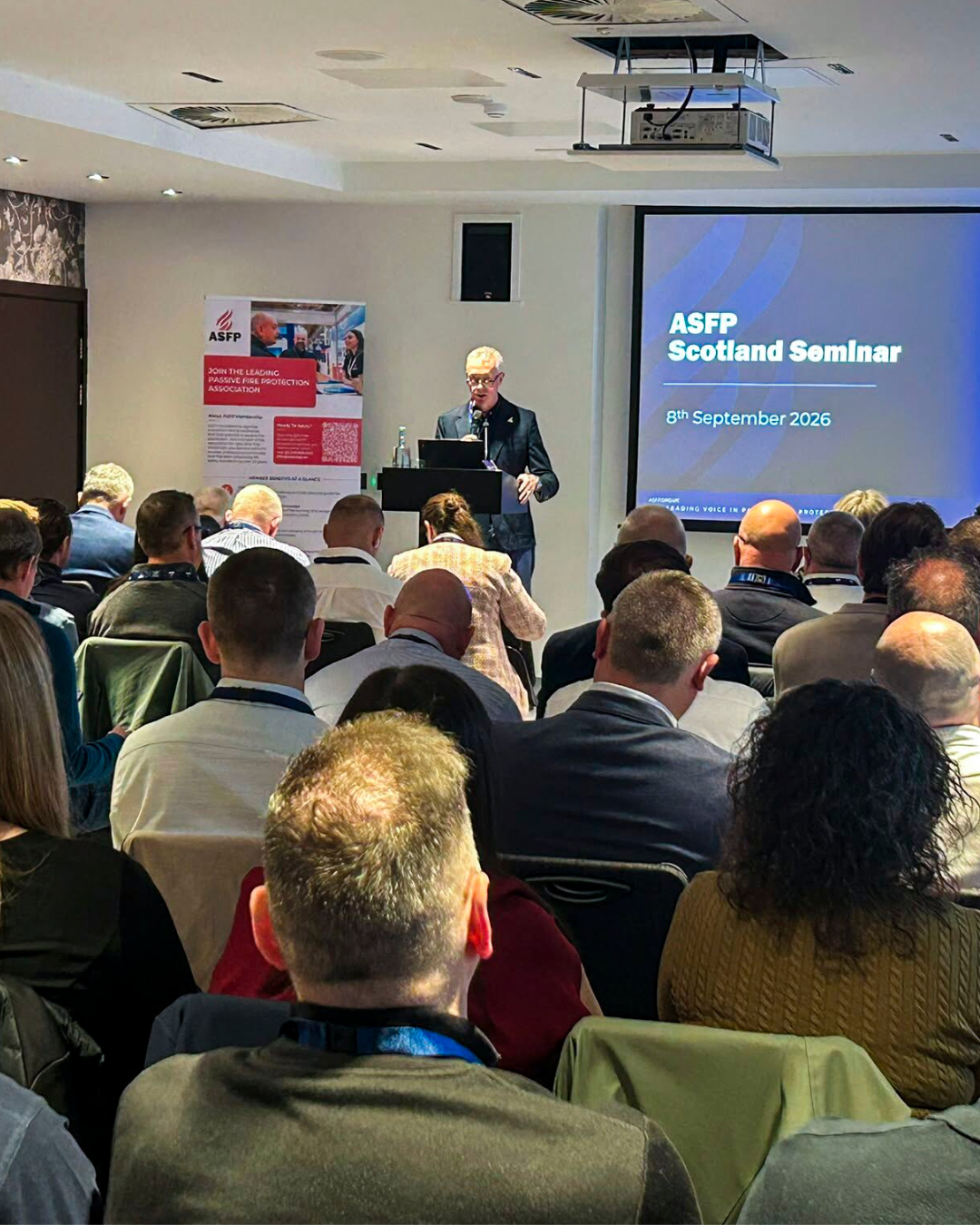
Whilst many important points were made, the key message was that effective fire safety depends on competent people, accountable organisations and coordinated decisions across a building’s life cycle.
Hannah Mansell (ASFP Consultant / ADOORABILITY) started the day by demonstrating the importance of fire doors and fire-resistant glazing. She pointed out that these products must be treated as complete systems rather than isolated components and argued that their performance depends on their intended use, interfaces, test evidence, classification, installation information, certification and traceability. The correct specification is only the starting point; installation, maintenance, and interaction with adjacent construction ultimately determine whether a system performs as intended.
Andrew Taylor (ASFP) then covered regulatory reform within Building Standards. He outlined proposed construction-product reforms which included broader product coverage, stronger enforcement, improved access to test evidence, greater oversight of conformity-assessment bodies and clearer responsibilities for manufacturers, designers and contractors.
Stephen Garvin of the Scottish Government then placed these changes within Scotland’s regulatory landscape. He stated that from April 2026 the regulatory changes affect cladding, cavities, means of escape, premises information and suppression systems. The clear takeaway here is that all duty holders must remain informed and must be prepared to adapt their processes.
Luke Cadman and Fraser McCourt of Astute Fire Engineering discussed how external wall systems continue to be scrutinised. They explored wall types, façade behaviour and the limitations of assessment. FRAEW (Fire Risk Appraisals of External Walls) and Scotland’s Single Building Assessment provide valuable starting points, but they are neither detailed remediation designs nor compliance certificates. Their findings lead to further surveys, testing, or replacement of barriers, cladding and insulation before a competent multidisciplinary team develops the final solution.
This challenge is heightened in traditional building conversions as the buildings can’t start with a clean sheet. The building-specific fire strategy is informed by existing structures, finishes, cavities, concealed voids, earlier alterations and vulnerable historic fabric. Additionally, remediation can reveal additional complications, including material compatibility, structural loads, thermal performance, restricted access, concealed defects and doubts over whether available fire tests properly represent the proposed construction.
The seminar then moved on to competence, and how this is the backbone of every stage of a building’s lifecycle. David Marah (ASFP Competence Specialist) challenged delegates to consider who is accountable for managing competence, whilst George Winters (representing Scottish Fire and Rescue Service) reinforced that competence is both individual and organisational. Fire risk assessments must be specific to each premises, evidence-based, current and capable of driving action. They must match both the assessor’s expertise and the complexity of the building.
Overall, the seminar’s main takeaway was that passive fire protection is a shared responsibility. Regulators, manufacturers, specifiers, contractors, fire engineers, building owners and enforcement bodies must exchange knowledge, challenge assumptions and maintain traceable evidence. Compliance remains fundamental, but lasting confidence comes from competent judgement, collaboration, specification and installation through occupation, maintenance and remediation.
Watch the highlights from the Scotland Seminar on the ASFP's YouTube channel.