The three-day event offered ASFP members the chance to engage with one another, procure products and services, and grow their professional network. ASFP’s year-on-year growth has meant that membership is so large that we are now working harder than ever to ensure there are opportunities for members to network and create meaningful relationships.
Visiting designers, engineers, and authorities loved the ASFP pavilion as they felt it was a safe space to discuss more in depth subjects, including future project designs, without feeling the ‘hard sell’ pressure they might get at other stands or pavilions. Personal highlights for myself included presenting an award at the Intersec awards, as well as ASFP representing and networking for and on behalf of ASFP members at the UK Trade & Industry reception at the British Embassy.
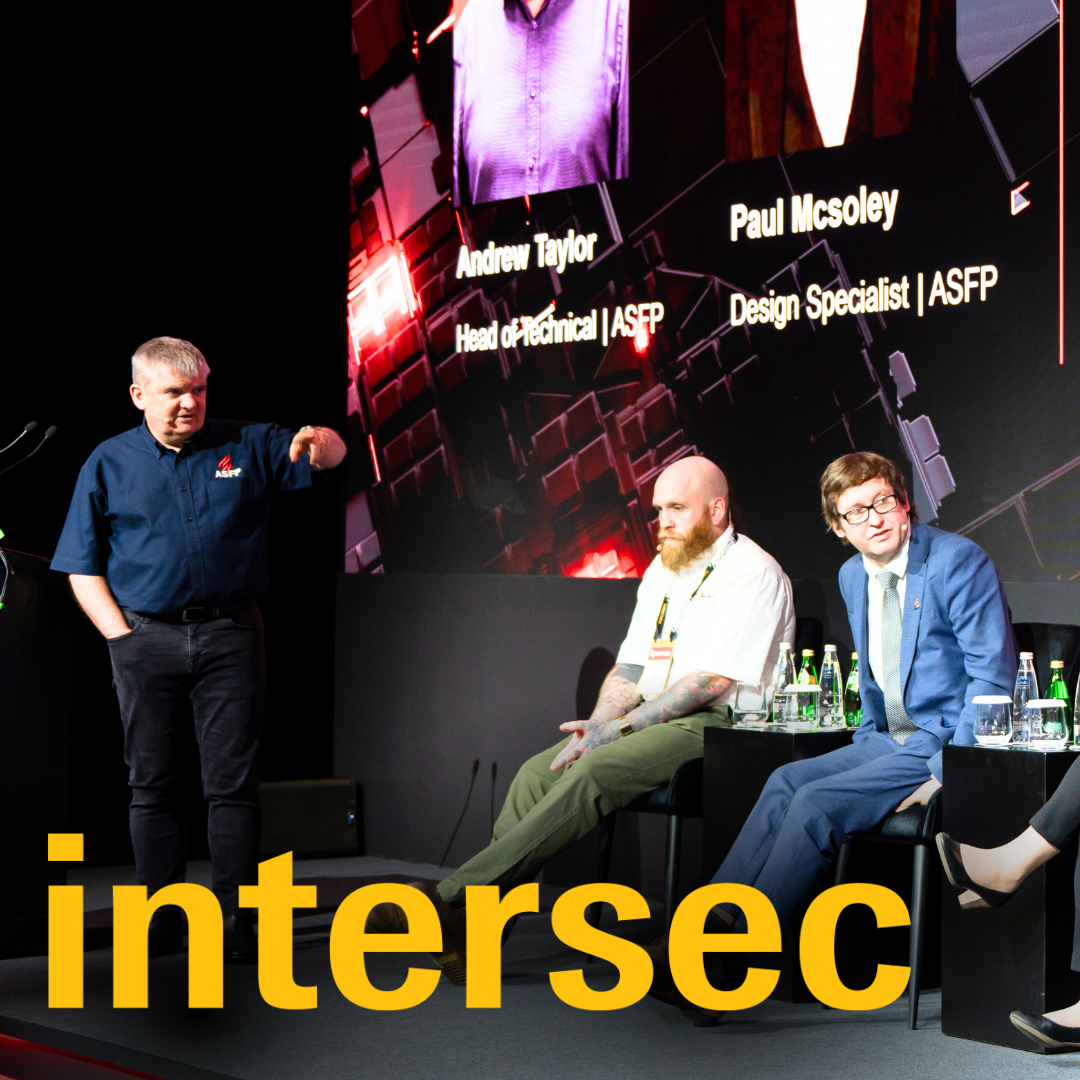
ASFP also ran a full day of presentations and panel sessions in the Intersec fire theatre. Paul McSoley, ASFP Consultant, presented a systematic approach to passive fire design. He explored how legal duty holders can work collaboratively to manage building risk conditions and arrive at appropriate, compliant system designs through structured and transparent decision-making. Andrew Taylor, ASFP’s Head of Technical, examined the relationship between Construction Product Regulations and UK Building Regulations. His presentation clarified how products demonstrate performance and compliance through CE and UKCA marking, and how these requirements integrate with the wider building safety and regulatory landscape.
ASFP led a high-level panel discussion examining how improved passive fire protection can enhance building safety across the global built environment. Chaired by Dr Andrew Taylor and Paul McSoley, the panel addressed key themes including restoring confidence in certification systems, understanding emerging global regulatory developments, exploring opportunities for harmonised international standards, and strengthening competence across the entire passive fire lifecycle. Contributions from industry experts Celine Abadie (Global R&D Manager, Jotun), Jamie Rogers (Chief Commercial Officer, CLM Fireproofing), David Campbell (General Manager, Emirates Safety Laboratory), and Will Cotterill (Founder, Fire Compliance Plus) provided a technically robust perspective on the future of passive fire protection on a global scale.
Hannah Mansell, ASFP Consultant and Fire Door Specialist, delivered a focused presentation on Specification, Installation & Compliance in the Evolving Building Safety Landscape. Targeted at stakeholders involved in fire door safety management, the session explored the critical links between design, specification, procurement, installation, and ongoing building management, reinforcing the importance of competence and compliance throughout a building’s lifecycle.
The programme continued with a presentation from Kate Milford, ASFP Competence Specialist, who addressed the critical importance of competence in delivering effective passive fire protection. Her session emphasised the role of structured training, third-party certification, and a clear understanding of design, installation, inspection, and maintenance practices.
This was followed by a panel discussion titled From Laboratory to Lifetime Service: Passive Fire Protection – Competence, Innovation, and Global Accountability. Moderated by Hannah Mansell and Kate Milford, the session explored how the built environment can rebuild trust in passive fire protection through increased rigour, accountability, and innovation. Contributions from Elliott Brown (Managing Director, Fire Door Inspector Inspectors), David Campbell (General Manager, Emirates Safety Laboratory), and Dr Andrew Taylor (Head of Technical, ASFP) grounded the discussion in real-world experience and examples of best practice.
ASFP’s expanded reach to the Middle East is a crucial stepping stone for creating a safer global built environment. We strongly urge any members of the ASFP to collaborate with us through exhibitor space or workshops at next year’s show. By spotlighting the work of our members in shows outside of Britain and Ireland, we can communicate the importance of competence and professionalism within passive fire on a global scale - and in turn, educate those who wish to follow the standards we have set so far.
Mike Ward, Managing Director ASFP